It holds water against the shingle
Algae behaves like a sponge. Instead of water running off your roof, it sits in contact with the shingle surface for days after the rain stops.
Roof Cleaning
We take the black streaks off the way they should come off — low pressure, no granule damage — and then we tell you what those streaks were telling you about the shingles underneath.
Why algae grows here
Those black streaks aren't dirt. They're algae feeding on your shingles — and they grow where the granules have already thinned.
The organism is Gloeocapsa magma, a blue-green algae that is endemic to the Gulf Coast. Warmth year-round, humidity that never really lifts and rainfall that has run from 59 to over 88 inches in recent years give it conditions it could not ask for improvement on. North-facing slopes, shaded pitches and anything under live oak or pine go first, because those surfaces stay damp longest after rain.
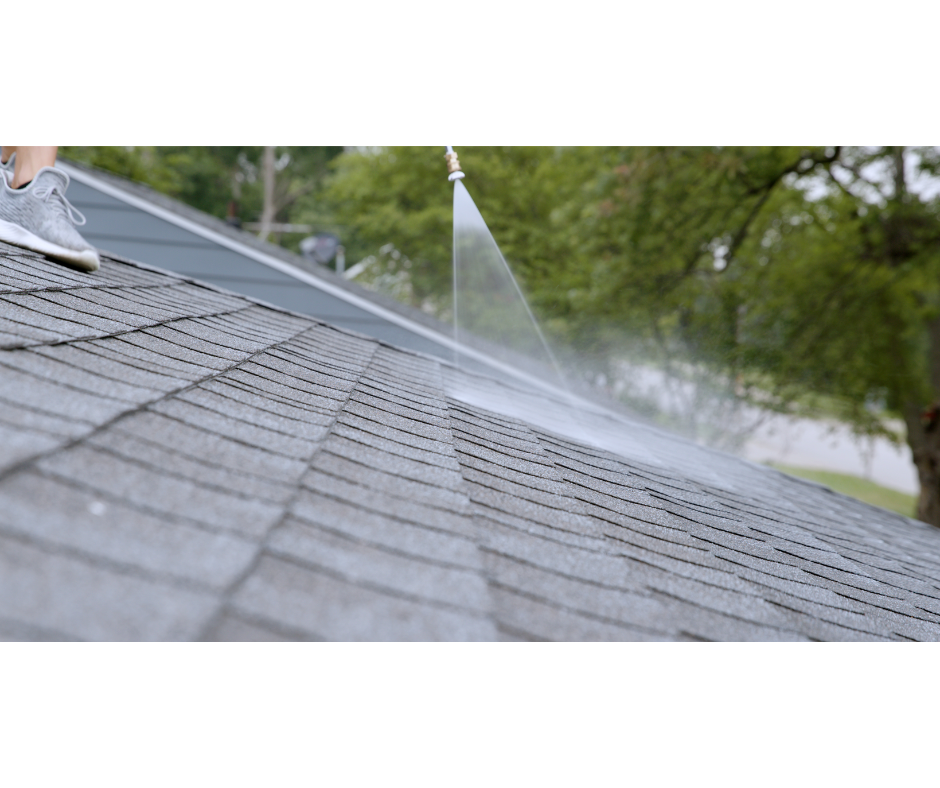
Algae behaves like a sponge. Instead of water running off your roof, it sits in contact with the shingle surface for days after the rain stops.
Asphalt shingles contain limestone filler. That's what the algae is eating. This isn't a stain sitting on top of your roof — it's an organism consuming part of it.
Algae needs a surface that holds moisture. A shingle with full granule coverage is a poor host. If it's thriving on your roof, the granules have already thinned.
We do not pressure wash roofs, and you should be careful with anyone who offers to. High-pressure water strips granules off an aging shingle by the handful — it makes the roof look better for a season while taking years off it.
Our approach is a roof-safe, low-pressure soft wash with manual clearing where it's needed, followed by a rinse and a full site cleanup. Gutters and downspouts get cleared of what comes off. Landscaping is protected before we start.
Rejuvenation restores the oils in the shingle. It can't do that through a layer of algae, and applying it over one means treating a roof that's still being fed on. So the algae comes off first. On most Escambia County homes both happen on the same visit — a soft wash, thirty minutes, then the treatment.
That's also why the two are quoted together. A soft wash on its own is a cleaning. A soft wash as preparation for rejuvenation is one job, and it's priced as one job.
Roof-safe low-pressure cleaning, gutters cleared, full cleanup. The right call if your roof doesn't qualify for rejuvenation or you're not ready for it.
Cleaning and treatment on the same visit, quoted as a single job at a combined rate. The roof gets clean and the reason it got streaked gets addressed.
Pricing for both options is quoted after the free inspection. Rejuvenation is only appropriate for asphalt shingle roofs that qualify.
No. High pressure strips granules from asphalt shingles and shortens the life of the roof. We use a low-pressure soft wash with manual clearing where needed.
On the Gulf Coast, eventually — that's the climate. How fast depends on shade, tree cover, roof slope and the condition of the shingle surface. A roof that's holding its granules resists regrowth far better than one that isn't.
Yes. Plenty of roofs need the algae off and aren't candidates for treatment. Junior will tell you which category yours falls into.
Usually not. They mean the surface has been holding moisture and the granules have thinned. That's often exactly the condition rejuvenation is designed for — but the only way to know is to get up there and look.
Serving Pensacola, Gulf Breeze, Milton, Pace, Navarre, Cantonment, Perdido Key and the rest of Escambia and Santa Rosa Counties. Free inspection, honest answer, written quote. If your roof needs replacing instead, we'll say so.